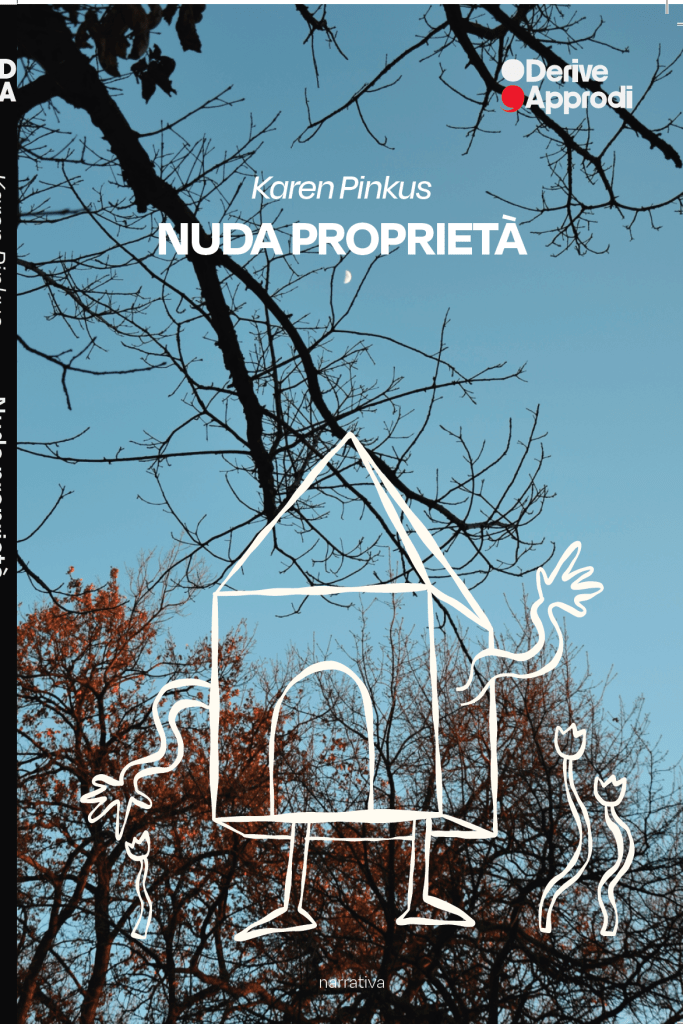
Nuda proprietà is out! Order here or at your favorite bookstore.
The opening to Nuda Proprietà, in English, has appeared in Embark, Issue 24, April 2026. There are a number of wonderful openings to check out here.
Here’s a summary in English: Franca, forty-something, signs a contract for an apartment in one of the most prestigious areas of Rome. The price is well below market value, and she pays cash, thanks to an advance on her modest future inheritance. There is only one catch: It’s a nuda proprietà, meaning that Franca can’t move in—she can’t leave the family home (or her elderly father’s constant wheezing), eat what she wants, listen to the radio when she wants, open the window to let in a breeze—until the former owner, now “the occupant,” an 87-year old woman with age-appropriate conditions—passes on to the next realm. Creative solutions are called for.
Nuda proprietà sets the story of Franca against the background of two major pandemics, Italy’s gerontocracy/demographic collapse, and the city of Rome—stupendous and decrepit, filled with rats, mafia; and occasional empty piazzas with magical fountains. The style is darkly comedic, drawing on the sparse prose of true crime writers, but with a definitive feminist touch. It is a novel about waiting—an Italian editor compared it to Giorgio Bassani’s Desert of the Tartars, if that rings a bell.
Other work in Progress:
A short play, Baaaah or, an Action of the Syndicate of Sheep to the Seigneur Against the Planned Revolt of Certain Human Associates of Social Tendencies. A surreal pastoral, a sheep-led counterrevolution against a group of socialist shepherds.
A one-act play Still Life with Rat and Parrot. Animals (I sense a theme) and humans meet in a museum gallery and reflect on Art History, vanitas, and memory loss.
A full-length play, Freakshow. I first got the idea for this play about a black man who survives a volcanic eruption on a Caribbean Island and is exhibited in a freakshow in Europe when I was an undergraduate student, centuries ago. It’s had a few staged readings so far.
A one-act in progress, Deaccession. Two white ladies of a certain age discuss plans for a museum to deaccession an eighteenth-century painting featuring a black slave who comes to life and aspires to join the Continental Army.
A novel in progress, titled Swans do not Eat Candy. It begins in New York in the 1960s and moves forward in time and space. It follows a long-standing class action law suit against an American toy company and ends up…well, no spoilers for now. Here’s the opening:
1966
Before they sat down to eat, the family members drew thin wooden sticks, bundled, upside down, from a lacquered container. Whoever drew the stick with a gold tip was supposed to open a topic that the family would adhere to, more or less, for the entire meal. On this evening, the youngest of the four children, Matty, short for Matthew, arrived in the dining room still immersed in his favorite cartoon: Adventures of a black-and-white locomotive featuring a pair of primitively-overgrown lips through which he emitted a series of “toots” and a phrase that sounded to grownups like “choo choo mother fucker,” but was obviously something else. Matthew imagined he was the train maneuvering through the apartment, led by a large white nose that he often blew into a handkerchief, using two gloved hands that disappeared into his sides when he finished), and crudely circular eyes without lashes or brows to humanize them.
The last thing on Matty’s mind was the gold-tipped stick. He certainly wasn’t expecting to pull it. A statistician might have calculated the number of times it would fall to each member of the family, factoring in that one or more of the older children was often absent from the dinner table, away at a school trip or visiting friends; or the parents might be away for work, though rarely both together since they planned their commitments thoughtfully; or that a family friend or cousin might be in attendance. Somehow Matthew was not often the standard-bearer of the evening conversation, either because of pure luck or, if you believe in such things, a kind of karma that spared him the responsibility for now, even though for a child of his age, he was remarkably articulate, perhaps in some measure due to the nightly ritual itself or the general atmosphere of the family or the progressive private school he attended where verbal expression was stressed above math or science or practicalities, where the children learned to read Hannah Arendt before they learned to tie their shoes, a principal said. Where instead of gym or ball games, the children put on special slippers and danced with scarves on a spongy floor during “fizz-movement.”
Matty had not prepared anything to talk about, so that when the family sat down and the plates had been filled and each of the four children, Bruno, born during the law school Christmas holiday, Sebastian, born a year and a half later, between summer internships and the start of the fall semester, Janet, born between graduation and the bar exam, and Matty, born in July so that his parents could work part time during the month of August when the partners were at their beach houses, had a glass of milk or juice and the parents–the children called them by their first names, Nat, for Nathaniel and Bobby, for Roberta–had water and wine, and when all eyes turned to Matty, he hesitated for a moment and then blurted out: “a girl with a patch on her eye.” Then the questions started:
“Was this girl in your class?
“Was it a costume?”
“Was she hurt?”
“Was she a pirate? Is she still a pirate?”
“Do pirates still exist?”
“Is there any age limit for piracy?”
“Are there any female pirates?”
“How was she hurt?”
“Did the other children tease her?”
Matty was running his engine and following a route that would take him up and down hills so sometimes his caboose would be dragged along and sometimes it would rush forward and bump into the last car. He heard about a third of what was being said and understood even less: …pirates as heroes…a form of anti-capitalism…blah blah blah… Peter Pan…no, not the one on tv…Yes, the 1954 Broadway production. Yes, we took Bruno…that’s the one on the original cast album…I gotta let go—AND CROW…er er er er er er er er er er!!!…Of course he was played by a woman. Yes, Mary Martin… er er er er er er er er er er!!!…did you know she really did grow up a tomboy? Don’t all look at me (that was Janet, who refused to wear skirts and liked to play in the mud)…Broadway is a desert this season. Nothing!…Pass the butter…A desert! You took two portions of cucumber salad!…What!!!! Don’t put it back in the bowl after your fork touched it…clatter clatter…Ooops. Some chicken must have fallen onto the rug but the Irish setter, Heidi, was there to get it. Clatter clatter chew chew…blah blah blah.”
Finally: “Let’s give Matty a chance to tell us what he meant.”
So Matty had to shut off the engine and park himself in the depot.
A piece of metal from a spinning top had landed right in the eye of one of his classmates, Rose H. Not Rose B. “The poor thing! Wasn’t she one with a white mother and a…yes, that’s her…blah blah blah…Child protection laws…blah blah blah…regulation… I Gotta let go…er er er er er er er er er ER!!!”

